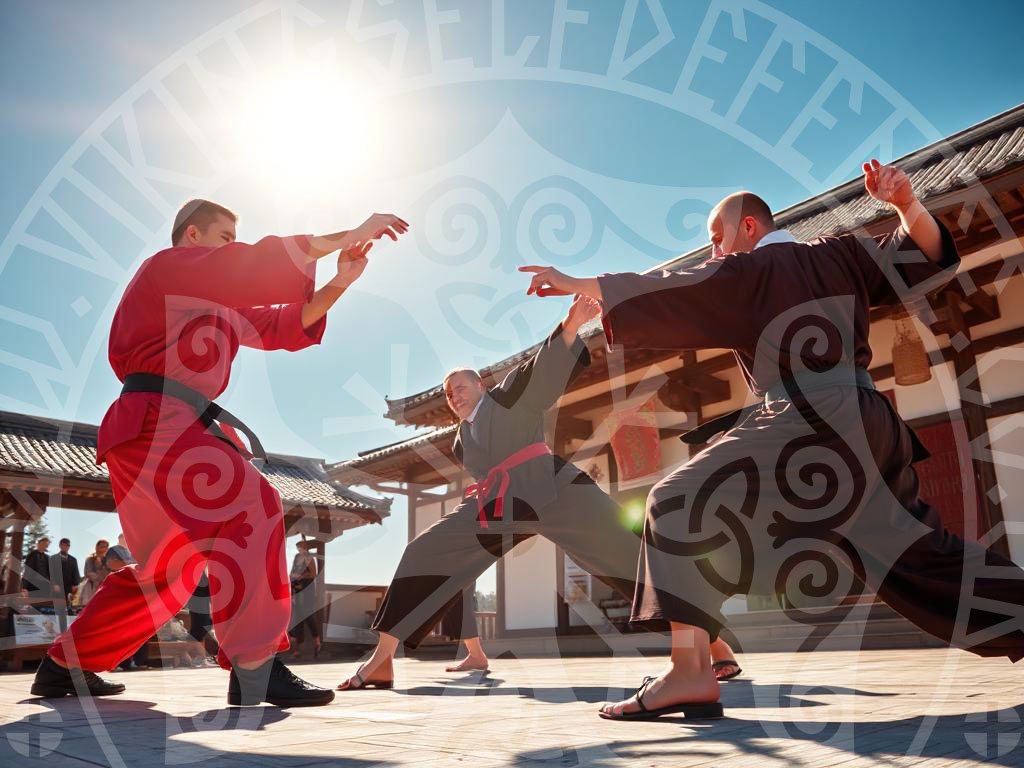
Martial arts have been practised for centuries, evolving through different cultures and regions. Despite their varied origins and distinct techniques, a closer examination reveals an intriguing interconnection among these diverse fighting systems. The saying “nothing new under the sun” aptly applies here, as the similarities between martial arts highlight the overarching theme that true mastery lies not merely in adherence to one particular style or system, but in understanding and adapting the strengths and weaknesses of various arts. This essay explores how different martial arts are closely linked, emphasising cultural influences, and the pivotal role of instructors in shaping a practitioner’s journey.
At first glance, the martial arts of China, Japan, Brazil, and other countries may appear distinct, characterised by unique forms, philosophies, and applications. For instance, Chinese Kung Fu is known for its fluidity and extensive forms, while Japanese Karate emphasises linear movements and powerful strikes. Brazilian Jiu-Jitsu focuses on ground fighting and submissions, whereas Muay Thai from Thailand excels in strikes involving the fists, elbows, knees, and shins. However, despite these differences, at their core, all martial arts share fundamental principles such as balance, timing, movement efficiency, and a keen understanding of human anatomy and psychology.
The cultural context plays a crucial role in the evolution of martial arts. Each system is a reflection of the environment and historical circumstances from which it emerged. For example, the disciplined, militaristic approach of Japanese martial arts can be traced back to the samurai code of Bushido, emphasising honour, discipline, and respect. In contrast, the Brazilian lifestyle, with its emphasis on adaptability and improvisation, is mirrored in Jiu-Jitsu’s fluid transitions and strategic problem-solving. Thus, while there might be stylistic differences, the underlying emphasis on cultural values and survival tactics remains universal.
The true essence of martial arts lies not in rigid adherence to a single system but in the practitioner’s ability to adapt and integrate. Every martial art has its strengths and weaknesses. Striking arts like Karate and Taekwondo are formidable at range but may struggle at close quarters, where grappling arts like Judo and Brazilian Jiu-Jitsu excel. Recognising this, many contemporary martial artists adopt a mixed approach, taking effective elements from multiple disciplines to become more versatile fighters. This reflects Bruce Lee’s philosophy of “using no way as way, having no limitation as limitation,” which urges practitioners to transcend the boundaries of style.
Instructors play an indispensable role in this integrative process. A skilled teacher not only imparts technical knowledge but also instils an understanding of the martial art’s philosophy and cultural significance. They encourage students to appreciate the similarities across different systems and to respect practitioners from other disciplines. Through open-mindedness and continuous learning, instructors can create a space where martial artists are encouraged to explore and adapt, rather than rigidly adhere to one brand or style.
In conclusion, martial arts are a testament to humanity’s shared need for self-defence, discipline, and self-improvement. While the techniques may vary, the similarities among different martial arts underline a universal truth: the most effective martial artist is not confined by any single system but is one who sees beyond the surface, embracing the strengths and learning from the weaknesses of all. By recognising this interconnectedness and drawing on the wisdom imparted by instructors, practitioners can cultivate a more holistic and adaptable approach to martial arts. Thus, truly, there is nothing new under the sun, except for the endless possibilities that arise from blending tradition with innovation in the ever-evolving world of martial arts.
Checkout more about what we do 52 Blocks boxing, lightning Scientific Arnis, Lyte Burly 52 Blocks